
AI Content Do’s & Don’ts: Balancing Human Creativity with Automation
Blog post description.
Taneea Pasarri Gupta
1/27/20264 min read
AI Content Do’s & Don’ts: Balancing Human Creativity with Automation
How to Produce Ethical, SEO-Friendly AI Content That Actually Performs
AI Is Not the Enemy of Creativity, its Misuse Is
Artificial Intelligence has officially entered the content marketing mainstream. From blog writing and email campaigns to SEO optimization and social media captions, AI tools are now capable of producing content at scale, speed, and surprising accuracy.
But here’s the uncomfortable truth about AI. “AI content that lacks human judgment, intent, and ethics doesn’t just perform poorly, it damages trust.” Yes, it does.
Search engines are getting smarter, audiences are becoming more discerning and brands that blindly automate content without editorial oversight risk losing both rankings and credibility.
This pillar guide explores how to responsibly use AI for content creation, without sacrificing originality, search performance, or ethical standards. We’ll cover practical AI content do’s and don’ts, SEO best practices, intent-driven strategies, schema usage, topic clustering, and multi-channel repurposing, all through a human-first lens.
Let us first understand the Role of AI in Modern Content Marketing
How AI can be used in Content Marketing:
AI excels in speed and scalability, pattern recognition, keyword expansion, draft generation, content summarization and content repurposing. If used correctly, AI becomes a co-pilot, not a replacement.
AI struggles with original insights, emotional intelligence, cultural nuance, brand voice consistency, ethical judgment and strategic prioritization.That’s where humans remain irreplaceable.
When I write a blog or an article, I use AI for ideation, captions, keywords and first draft. Any user will read my blog only if it provides value or helps in solving a problem. Keeping that in mind, I constantly read and edit my blog to see if it actually provides value. Adding a few examples and experiences is like a cherry on the cake.
The Do’s of Ethical, SEO-Friendly AI Content
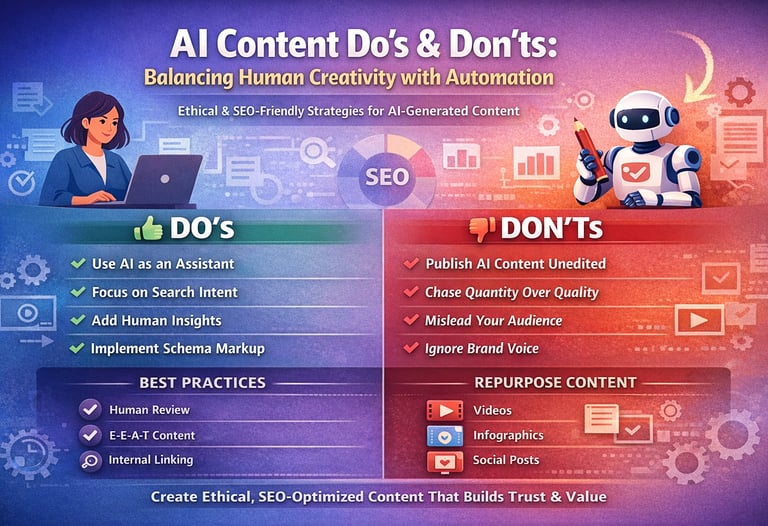
1. DO Use AI as an Assistant, Not an Author
AI should support ideation and efficiency, not own the narrative. It can be best used for first drafts, content outlines, meta descriptions, FAQs and topic expansion. As an editor, try adding some insights and examples, refine tone, inject brand personality. Most importantly, validate the facts from a reliable source. Do not publish the content without human edit.
2. DO Focus on Search Intent, Not Just Keywords
Modern SEO is intent-driven, not keyword-stuffed. Instead of asking “What keyword should I rank for?”, one should ask “What problem is the reader trying to solve?” AI tools help identify keyword variations, but humans must map them to intent.
3. DO Add Original Human Insights
Search engines reward Experience, Expertise, Authoritativeness, and Trust (E-E-A-T). First-hand examples, industry observations, case studies, contrarian perspectives and data interpretation. Trust me, I have gained many content retainerships, pitch desk projects and social media campaigns by just adding my words that work like magic. AI can summarize the content available on the internet, it cannot give meaning to it.
The Don’ts of AI Content (That Hurt Rankings & Trust)
1. DON’T Publish AI Content Without Review
Unedited AI content often contains repetitive phrasing, over-generalizations, factual inaccuracies, and robotic tone. Search engines increasingly detect low-value automation patterns.
2. DON’T Chase Volume Over Value
Publishing 50 AI blogs a month means nothing if they don’t provide answers, if they lack depth or if they compete internally for keywords. One high-quality, well-structured post outperforms 10 unedited AI posts.
3. DON’T Use AI to Mislead Audiences
Ethical violations include fake authorship, fabricated statistics, and AI-generated testimonials. Trust once broken is hard to rebuild whether it is for users or search engines.
4. DON’T Ignore Brand Voice & Tone
AI uses neutral, generic and over-polished language. The solution is to edit the draft in such a way that matches your style of language and writing. When you represent a brand, the audience connected with you knows your style of presentation or the way you play with words. The new audience also gets connected when they find human intervention rather than robotic language.
Tip: Humans make mistakes and so should you.
How to Create Ethical AI Content — A Practical Workflow
Step 1: Human-Led Strategy: Define your target audience, Identify the topic based on your niche and choose the funnel stage of your audience that you want to target.
Step 2: AI-Assisted Drafting: generate outline, expand sections, create FAQs
Step 3: Human Editing Layer: fact-checking, adding insights, personalising language flows and optimising tone.
Step 4: SEO Optimization: Internal links, meta tags, schema markup and readability checks
Step 5: Multi-Channel Repurposing: Repurposing Blogs to linkedIn carousel, short video script, infographic and email newsletter.
Repurposing AI Content for Multi-Channel Visibility
AI enables content multiplication, not duplication.
Blog to Video: extract 3 key ideas, convert them into 30–60 second scripts and add human voiceover for authenticity.
Blog to Infographics: Convert them into Stats, frameworks and checklists.
Blog to Social Content: add the link of the blog to social networks with hook lines, quotes and micro-insights.
Repurposing improves reach, brand recall, SEO signals and ROI per content piece.
Measuring Performance Beyond Rankings
Track organic engagement, scroll depth, time on page, assisted conversions and content-driven leads. AI content that ranks but doesn’t convert is still failing.
The Future of Human Centered AI Content
Search engines are not anti-AI. They are anti-spam, against low-value content
And against manipulation. The future belongs to brands that use AI responsibly, prioritize users, invest in editorial quality, build trust through transparency.
FAQs: AI Content, Ethics & SEO
Is AI-generated content penalized by Google?
No. Google evaluates content based on quality and usefulness, not how it’s created.
Should I disclose AI usage in content?
Not necessary only if you have checked the facts and sources of information.
Can AI replace human writers?
AI enhances writers, but cannot replace strategic thinking, creativity, or ethical judgment.
How much AI usage is “too much”?
If AI output dominates without human input, editing, or insight, then it’s too much.
Final Takeaway
AI content isn’t about shortcuts, it’s about smart systems. When human creativity guides automation, content becomes ethical, SEO-friendly, scalable and trustworthy. And that’s exactly what modern audiences and search engines reward.