
Financial Literacy: Creating Helpful Educational Content
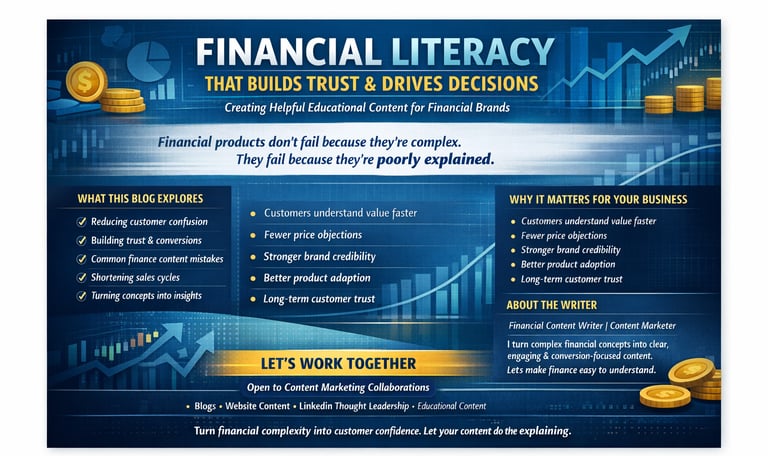
I break down how financial education content can: • Reduce customer hesitation • Improve trust in financial products & pricing • Shorten sales cycles • Position brands as credible financial advisors not just sellers
Taneea Pasarri Gupta
1/28/20262 min read
Financial Literacy: Creating Helpful Educational Content
In this era where traditional finance is fading and technology-driven finance is emerging, financial literacy to educate the businesses through content is very important. Due to competition, sustainability of business is not as easy as it used to be.
Q1. Why is financial literacy content important for businesses today?
Answer:
Because financially confused businesses don’t know how to set targets, set competitive prices and convert and retain customers and brand loyalty. Many businesses struggle with low confidence in financial decisions, long sales cycles due to unclear pricing or ROI and high churn caused by misunderstood financial commitments.
Solution:
Education through financial content builds decision confidence. When users understand concepts like cost breakdowns, returns, budgeting, or financial risk and their implications, they make faster and better choices benefiting both the customer and the business.
Q2. What is the biggest mistake companies make while creating financial education content?
Answer:
They teach concepts, not context. Most content explains what interest rates, cash flow, or budgeting are, but fails to explain how it affects a small business owner, why it matters right now, and what action should be taken next.
Solution:
Frame every topic around a real-world scenario. How poor cash flow planning blocks business growth or why unclear pricing creates customer drop-offs. Context turns information into insight.
Q3. How can financial literacy content help solve business trust issues?
Answer:
Transparency reduces resistance. When businesses don’t understand financial implications, they portray risk to the customers, even when none exists. This leads to price objections, decision paralysis and brand skepticism
Solution:
Educational content should help businesses explain the ‘why’ behind the pricing breakdowns, cost vs. value explanations and long-term financial impact comparisons. This positions your brand as a financially responsible advisor, not just a seller.
Q4. What type of financial content is most useful for modern audiences?
Answer:
Short, actionable, and problem-led content. People don’t want finance lessons, they want financial clarity. High-impact formats include:
FAQs that answer real buyer questions
“Common mistakes” explainers
Simple decision frameworks
Visual comparisons (cost vs benefit, short vs long term)
Solution:
Each piece of content should answer one core question: “What decision will this help the reader make better?”
Q5. How can businesses use financial literacy content to improve conversions?
Answer:
By removing financial uncertainty that a buyer goes through in the process of trusting a brand and buying journey. Unclear financial understanding causes cart abandonment, delayed approvals and multiple back-and-forths with sales teams.
Solution:
Create content that aligns with buyer decision stages such as an awareness about how much should you budget for the product, which option is financially smarter when comparing two products, and what ROI can you realistically expect. When customers understand the numbers, decisions speed up.
Q6. How do you simplify financial topics without oversimplifying them?
Answer:
Clarity comes from structure, not dilution. You don’t need to remove complexity, you need to organize it better.
Solution:
Use plain language, not jargon, break content into logical steps, explain one concept at a time and support explanations with relatable examples. Financial literacy improves when people feel informed and not overwhelmed.
Q7. How can financial literacy content support long-term brand authority?
Answer:
Consistency creates credibility. Brands that regularly educate audiences on financial understanding are seen as reliable, ethical and long-term partners.
Solution:
Build a financial education content pillar through regular Q&A blogs, explainer posts, case-based insights and decision-making guides.
Over time, this positions your business as a trusted financial voice, not just a service provider.