
How Generative AI Is Transforming Financial Research & Analysis
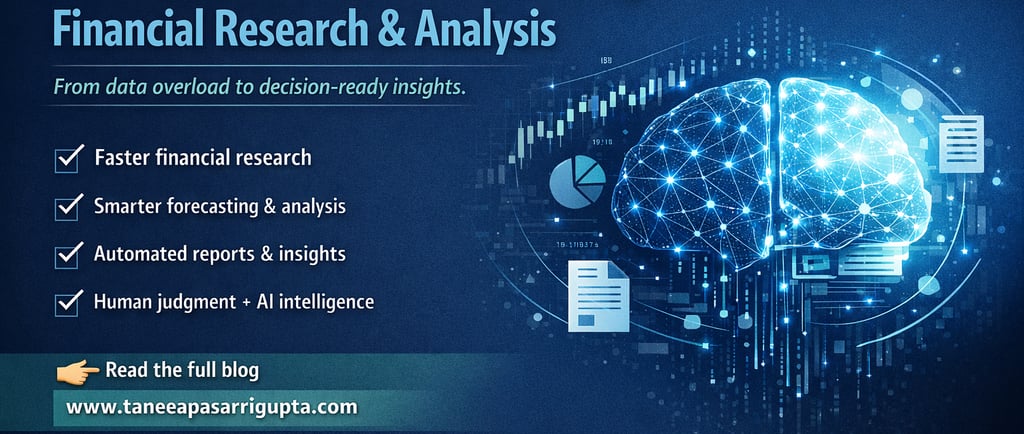
Generative AI is transforming financial research and analysis by automating data interpretation, enhancing forecasting accuracy, and converting unstructured financial content into actionable insights. In this blog, I explore: • How Generative AI improves financial research productivity • AI-powered forecasting and predictive analysis • Use cases in investment research, risk analysis, and market intelligence • The role of human judgment in AI-assisted finance • Ethical and regulatory considerations finance leaders must address This piece is designed for finance professionals, analysts, founders, and decision-makers looking to understand how AI is reshaping modern financial research beyond the hype.
Taneea Pasarri Gupta
2/6/20262 min read
How Generative AI Is Transforming Financial Research & Analysis
In the world of finance, data is king. But for decades, financial analysts have struggled with the sheer volume of information which includes spreadsheets, earnings calls, market data, regulatory disclosures, news feeds, and more. Traditional research methods are often slow, manual, and prone to human error.
Enter Generative AI, a powerful new technology that is reshaping financial research and analysis with unprecedented speed, accuracy, and insight.
1. From Data Overload to Insightful Summaries
Financial professionals are inundated with data every second. Generative AI models like GPT-4 can rapidly scan massive datasets, interpret complex financial language, and generate clear, concise summaries.
Instead of reading through hundreds of pages of reports or SEC filings, analysts can now receive automated insights that highlight key performance metrics, trends in earnings and revenue, competitive comparisons, risk factors and red flags. This saves hours, sometimes days of manual work.
2. Enhanced Forecasting and Predictive Analysis
One of the biggest advantages of Generative AI in finance is its ability to perform predictive analytics. Traditional models rely on predefined statistical methods. AI models, on the other hand, can learn from historical data patterns, incorporate real-time market changes and generate probabilistic forecasts.
This results in more dynamic and adaptive financial models capable of predicting stock price trajectories, revenue growth scenarios, macroeconomic shifts and market volatility impacts. By providing forward-looking insights, AI helps analysts make smarter investment decisions.
3. Natural Language Insights from Complex Content
Financial research often involves interpreting qualitative data like management commentary, news articles, or analyst transcripts. Generative AI can understand sentiment, extract key themes and transform raw text into actionable insights.
For example, AI can read through an earnings call transcript and summarize what executives emphasized, what concerns were raised, hidden implications for future performance etc. This bridges the gap between unstructured narrative and structured financial analysis.
4. Automated Report Generation
Writing research reports is time-consuming. Generative AI can automate earnings summaries, market trend reports, investment thesis and compliance documentation. These reports maintain professional quality, follow consistent formatting, and allow analysts more time to focus on strategy instead of typing.
5. Collaboration Between Humans and AI
Generative AI does not replace analysts, it amplifies their capabilities. Analysts work with AI as a collaborative research assistant refining outputs, asking follow-up questions, validating assumptions, and adding human judgment where nuance is needed. This synergy increases productivity while maintaining accountability and expert oversight.
6. Challenges & Ethical Considerations
Despite its strengths, Generative AI in finance isn’t perfect. Some of the key concerns are data quality & bias, regulatory compliance, transparency in AI decision-making, overreliance on automated outputs. Firms must ensure AI systems are audited, explainable, and aligned with ethical standards.
7. Real-World Use Cases
Hedge funds are using AI to scan global news and detect trading signals, equity research teams are generating automated investment thesis, risk teams are monitoring regulatory changes and compliance alerts, wealth managers are creating personalized investor reports. The competitive edge goes to firms that adopt AI early and wisely.
Conclusion: A New Era of Financial Intelligence
Generative AI is not a trend, it’s a transformation. It enables financial professionals to speed up research cycles, to derive deeper insights, to augment human expertise and make better, data-driven decisions. In an industry where timing and accuracy matter, AI delivers both.
As technologies evolve, financial research and analysis will become faster, smarter, and more strategic powered by human intelligence and machine insight working together.