
Tech Trends 2026: AI Agents & Personal Digital Workers — How Enterprises and Startups Are Scaling Smarter
AI Agents for business, Personal Digital Workers, AI Agents in enterprises, AI Agents for startups, AI automation trends 2026, Autonomous AI agents, AI digital workforce, Enterprise AI automation, AI agents use cases, AI-powered workforce, Digital employees powered by AI
1/31/20262 min read
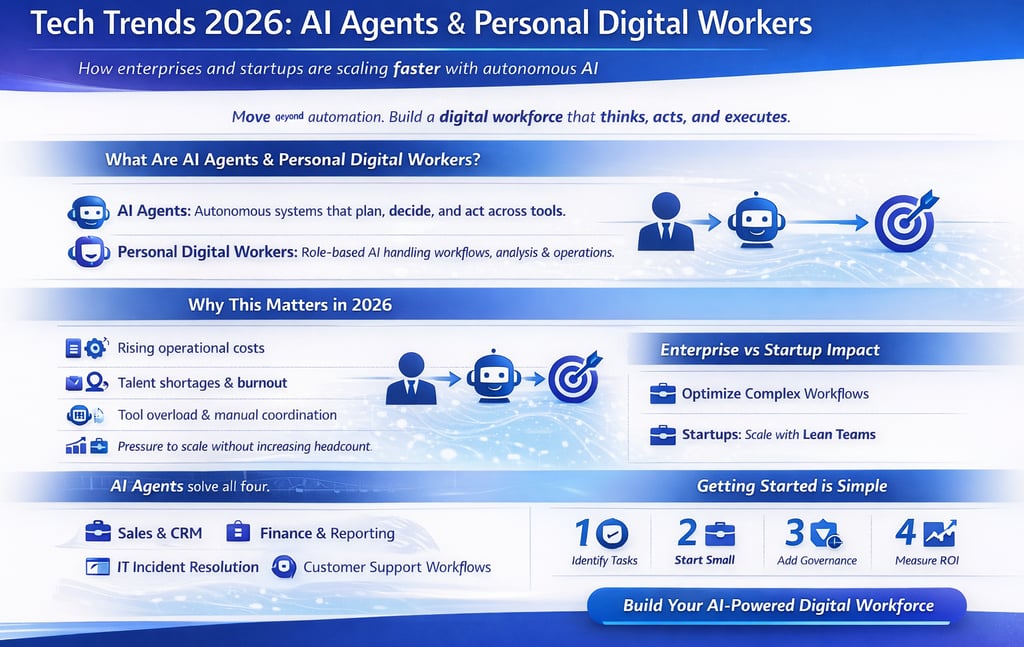
Tech Trends 2026: AI Agents & Personal Digital Workers — How Enterprises and Startups Are Scaling Smarter
As businesses move beyond basic automation, AI Agents and Personal Digital Workers (PDWs) are emerging as one of the most impactful tech trends of 2026. Unlike traditional AI tools, these agents don’t just assist, they act, decide, and execute within defined business goals.
Below is a practical Q&A that answers what business leaders actually want to know.
Q1. What are AI Agents and Personal Digital Workers are they different from chatbots or automation tools?
AI Agents are autonomous systems designed to complete multi-step tasks, make decisions, and interact with multiple tools or platforms to achieve a goal. Personal Digital Workers (PDWs) are role-based AI agents trained to function like employees handling tasks such as reporting, follow-ups, analysis, or coordination.
Traditional automation works only on predefined rules. AI agents adapt to context, reducing dependency on constant human supervision.
Q2. Why are AI Agents becoming a major trend in 2026?
Three factors are driving adoption:
Rising operational costs: Businesses need scale without linear hiring.
Mature GenAI ecosystems: Agents can now reason, plan, and act.
Workforce overload: Employees spend 30–40% of time on repetitive coordination tasks.
AI agents bridge this gap by acting as force multipliers, not replacements.
Q3. How are enterprises using AI agents today?
Enterprises are deploying AI agents in high-volume, decision-heavy workflows, such as:
Incident triaging, log analysis, auto-remediation
Invoice reconciliation, compliance checks, variance analysis
Resume screening, interview scheduling, policy Q&A
Lead qualification, CRM updates, forecast reporting
This results in faster cycle times, fewer errors, and teams focusing on strategic work instead of admin tasks.
Q4. How can startups use AI agents differently from large enterprises?
Startups use AI agents to replace entire operational layers, not just optimize them. For example, a single AI agent acting as a virtual operations manager, PDWs handling customer onboarding, support tickets, and follow-ups, AI agents running market research, competitor tracking, and reporting. Startups scale like a 20 person team while operating with 5, without burning out founders.
Q5. What business problems do AI agents solve better than hiring more people?
AI agents excel where tasks are repetitive but contextual, data-heavy and cross-platform, time-sensitive but low creativity. This resolves problems like missed follow-ups and delays,
data scattered across tools, high cost of entry-level roles and inconsistent execution. They ensure consistency, speed, and availability.
Q6. Are AI agents secure and controllable for business use?
Yes, modern AI agents are built with role-based permissions, human-like approvals, audit logs and traceability and private model deployments. Enterprises define what an agent can do, where it can act, and when human approval is required.
Q7. What skills or teams are needed to implement AI agents?
You don’t need a large AI team. Most organizations succeed with a business process owner (who knows the workflow), a tech partner or platform for agent orchestration, clear success metrics (to analyze time saved, cost reduced, accuracy improved). The biggest shift is process clarity, not technical complexity.
Q8. What should businesses avoid when adopting AI agents?
Common mistakes include automating broken processes, expecting full autonomy from day one, treating agents as tools instead of digital teammates, ignoring environment change for employees. Successful adoption starts small with one workflow, one agent, one measurable win.
Q9. What does the future of AI agents look like beyond 2026?
AI agents will evolve into collaborative digital workforces that coordinates with other agents, learn from organizational data proactively suggest optimizations and align with business KPIs, not just tasks.
The future isn’t AI replacing humans, it’s humans managing outcomes while AI managing execution.