
Using Social Media to Build Trust in Financial Services
social media marketing for financial services, content marketing for financial services, financial services content marketing, trust building in financial services, financial advisor content marketing, content marketing for finance professionals
Taneea Pasarri Gupta
1/31/20263 min read
Using Social Media to Build Trust in Financial Services
Using Social Media to Build Trust in Financial Services
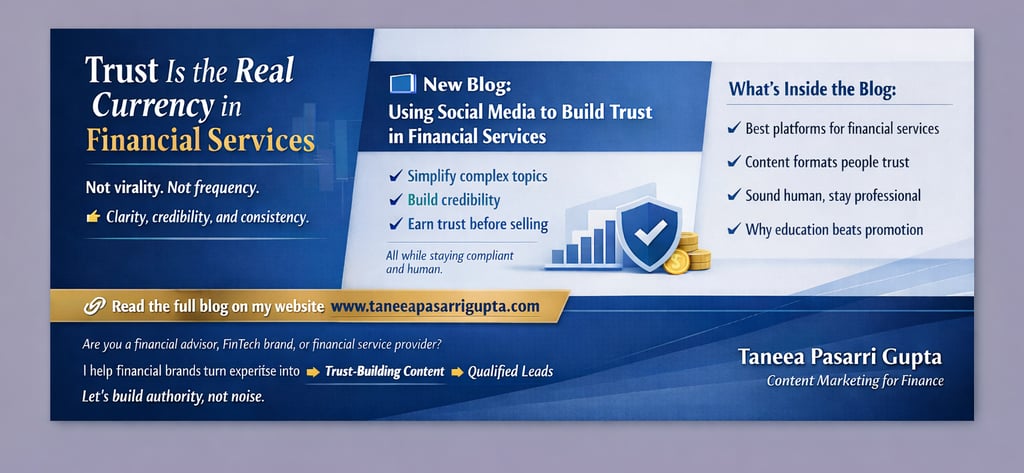
People don’t trust financial brands because they post more. They trust them because they post better with clarity, consistency, and credibility.
This blog covers:
Why trust is the real currency in financial services
Which social media platforms actually work (and why)
Content formats that build credibility fast
How to speak “human” without losing compliance
What to post if attention spans are short and skepticism is high
Facts that actually work:
Trust beats virality in financial content
Educational and transparent content outperforms sales posts
Short-form, repeatable formats work best
People trust faces, not logos
One honest post builds more trust than ten promotional ones
Why Is Trust So Hard to Build in Financial Services?
Because finance involves risk, money, and long-term impact.
People aren’t just scrolling for information, they’re silently asking: “Can I trust you with my money?” And social media is often the first touchpoint.
So… Can Social Media Really Build Trust?
Yes, if you use it right.
A financial advisory firm posted weekly market updates for years. This resulted in low engagement and no leads.
Then they switched to short explainers, founder-led videos, and real client questions. Engagement tripled and inbound queries followed. The expertise is the same but format is different.
Which Social Media Platforms Actually Work for Financial Services?
1. LinkedIn - It is best for authority and professional trust as most professional companies post their updates on LinkedIn. Wealth managers, Fintech brands and B2B financial service providers can use this platform to resonate founder insights, Market explainers, regulation clarity and case-led learnings. Use this platform as a smart colleague not a corporate brochure.
2. Instagram – It is best used for Relatability & Awareness. Yes, finance works on Instagram, if simplified. Carousels breaking down complex topics, reels explaining one concept in 30 seconds, and myth vs fact posts best works on instagram. People don’t want advice first. They want understanding.
3. YouTube – It is the best platform for deep trust & long-term value. It can be used for financial education and investment philosophy. YouTube builds trust slowly but deeply.
What Content Formats Build Trust the Fastest?
1. Q&A Content (Your Best Weapon)
People trust brands that answer real questions. For example, “Is now a good time to invest?”, “what are the risks nobody talks about?”, “How do I avoid common financial mistakes?” This positions you as helpful, not salesy.
2. Bite-Sized Educational Posts
No jargon. No lectures. Post should include one concept, one outcome and one clear takeaway. If it takes effort to understand, people scroll away.
3. Founder & Expert-Led Content
Faces build trust faster than logos. Short videos, personal observations and honest opinions (within compliance) from top managers and founders works like magic. People trust people who explain things calmly.
4. Transparency-Driven Content
Trust grows when brands stop pretending they’re perfect. For example, “What we don’t recommend and why”, “Who our services are NOT for”, “Risks you should know before investing.” This might look counterintuitive, but trust me, it's powerful.
How Do You Balance Compliance and Authenticity?
This is where most financial brands freeze. The simple rule is to be clear, not clever. Avoid promises, explain risks in plain language and focus on education, not persuasion. Trust comes from honesty, not hype.
What Does a Trust-Building Content Mix Look Like?
A simple, effective split is 40% education, 30% clarity & FAQs, 20% expert opinions and 10% soft brand presence. Consistency matters more than frequency.
Why Short Attention Spans Change Everything
People won’t “learn finance” on social media. They will save useful posts, rewatch clear videos and follow voices they understand. Your goal isn’t to teach everything, it's to teach one thing well, repeatedly.
Final Thought (And Action Step)
If your social media sounds like marketing, trust drops. If it sounds like guidance, trust grows. Ask yourself before every post: “Would I trust this brand if I were reading this for the first time?” That answer decides everything.